

Hermes
Centralized platform and process for tooling management
Project background
Every time an airplane requires maintenance, it's necessary to prepare in advance the tools that will be used. The team in question had difficulty in having an agile process and systemic tools that would support and integrate the internal ecosystems with suppliers and customers.
💼 About my customer
Operations division of a big aeronautical company in Brazil.
📝 My role
UX & Product Designer, focusing on business model, monetization and UI prototype.
⏰ Timeframe
2 months
Phase 1: reviewing our customer journey and mapping pain points ✍
Phase 2: ideation and proposing solutions 💭
🦸♂️ Champions (16 total)
-
7 Operation team members
-
2 Digital Transformation team members (including me!)
🔨 Tools
-
Power Point collaboration environment
1.1 Getting to know our customer
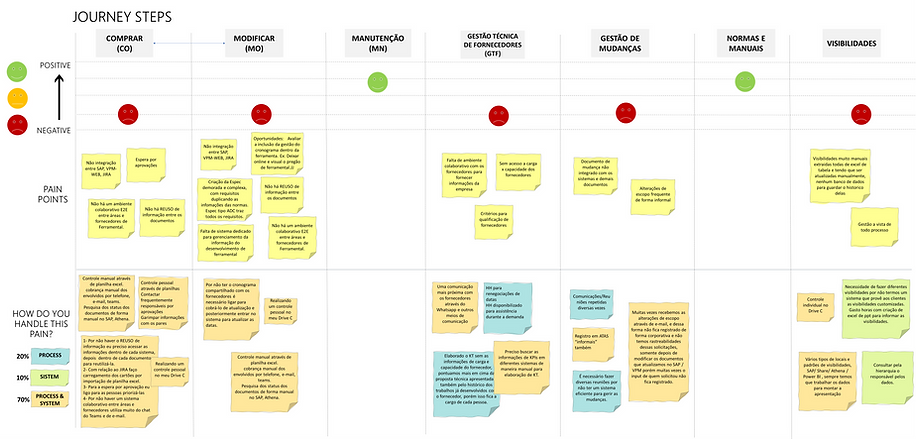
The first step was to understand the process that the team should follow and map it as a user journey. I asked the customers to identify which phases were not satisfactory and to describe the main pain points for each. Then, I asked them to explain how they handle (or resolve) each of these pain points considering the team's current process.
2.1 Mapping possible solutions (for new process and system)
In this phase, we took all the previously mapped pain points and asked the following questions: "What would be the best way to perform this activity?" and "What would be the best systemic functionality to support this process?". The first question refers to reviewing the processes, and the second one refers to ideating a system.

Phase 3: result synthesis 📈
This helped us develop a clear understanding of the best ways to carry out each activity and the required features to support the overall process effectively. The synthesized results will serve as the foundation for further improvements and the development of a more efficient and customer-centric system.

Results and takeaways 📝
The ideation report was delivered to the technical team and translated into technical system functionalities. Currently, the project is in the implementation phase. An essential lesson to take away from this project is the need to consider the entire customer ecosystem when planning the design of a solution. In this specific situation, it became evident that a new system alone wouldn't solve all the problems since the process also required restructuring. By addressing both the systemic functionalities and the process improvements, we ensure a more comprehensive and effective solution for the customer's needs.